
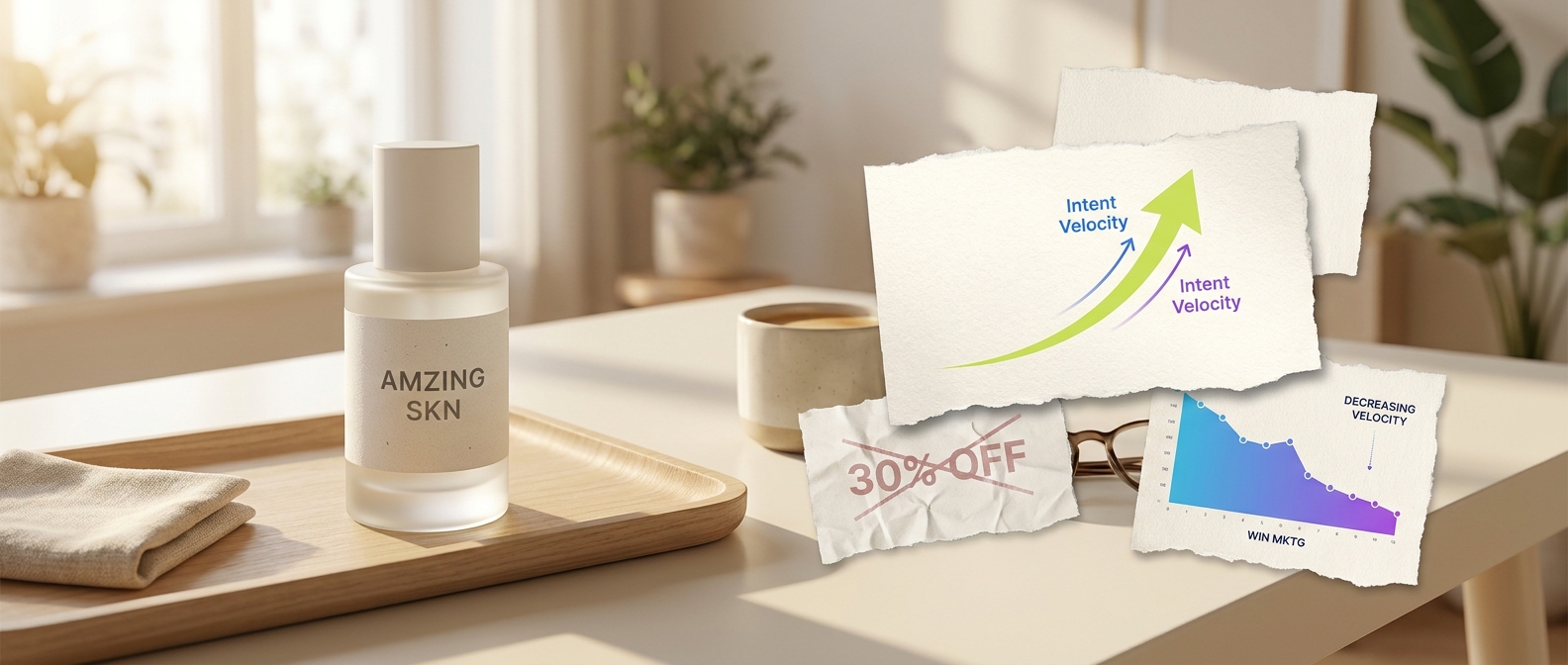
How can ecommerce brands reduce blanket discounts?
Short answer: Separate shoppers who are accelerating toward a purchase from those whose interest is fading. Remove unnecessary offers for high-intent shoppers, then reserve targeted incentives for qualified shoppers who show real hesitation. Measure contribution margin—not conversion rate alone—to confirm the strategy is profitable.
Key takeaways
- A cart or browse event does not prove that a shopper needs a discount.
- Interest velocity adds timing and historical context to ordinary behavioral signals.
- Non-discount value—such as relevance, exclusivity, education, or convenience—should be tested first.
- Success should be judged by incremental profit and contribution margin, not attributed revenue alone.
Key definitions
- Interest velocity
- The rate at which a shopper’s relevant behavior is increasing or decreasing over time.
- Category surge
- A concentrated increase in browsing or engagement within a specific product category.
- Contribution margin
- Revenue remaining after variable costs such as product cost, discounts, shipping subsidies, and payment fees.
The marketing advice you’ve been sold about “personalized discounting” often ignores the math. Automated exit-intent pop-ups and cart-abandonment coupons can recover sales, but they are not automatically precise. When every shopper receives the same incentive after the same trigger, the brand may be surrendering profit margin to customers who were already prepared to buy.
I’ve never met a founder or executive leader who didn’t tell me they wanted to save margin. You absolutely do not want to give away all your profit just to incentivize a conversion from someone in your CRM. That makes perfect sense. We don’t want to give away the farm. The entire promise of retention marketing is supposed to be securing additional purchases without surrendering your unit economics.
Yet, most of the best brands out there simply offer slightly different discounts for exit intent, cart abandoners, or returning visitors. While some agencies call that “precision discounting,” it’s really just the same old margin erosion wrapped in a different trigger.
The real trick is to only discount the customers who absolutely will not convert without it. But how do you actually identify those customers before they leave your site? How do you get them to buy from you before they buy from someone else? Are there leading indicators that someone is genuinely on the fence versus someone who is a dedicated full-time buyer?
This is the central challenge of retention marketing: distinguish shoppers who are already moving toward a purchase from shoppers who need more information, reassurance, or a well-timed incentive. When every visitor receives the same treatment, brands either give away margin unnecessarily or fail to address the friction that is actually blocking the sale.
The Mathematical Flaw in Your Current Retention Strategy
The “Precision” Discounting Myth
Every founder wants to stop training their customers to wait for the inevitable holiday markdown or automated coupon code. But the systems you use are actively encouraging this behavior.
Think about the typical Shopify store: A user hits a product page, idles for 15 seconds, and boom—a 15% off pop-up interrupts their screen. Or they leave an item in their cart, and exactly two hours later, an email arrives offering free shipping.
You may be handing a discount to a customer who would have paid full price minutes later. When customer acquisition is already expensive, subsidizing buyers who are already convinced compounds the pressure on profit.
Why Your ESP Is Blind to Reality
The conventional advice is to identify high-intent signals by tracking visits to pricing pages, using specific search terms, or logging repeat visits.
But isn’t this approach fundamentally flawed? It is completely blind to history.
It treats a first-time window shopper who looks at three products exactly the same as a long-time subscriber who looks at those exact same three products. Their real intent is completely different, but legacy platforms like Klaviyo, Braze, and Attentive overwrite profile properties every time a new action is taken. They don’t respect the historical context of a customer’s interest, storing only static states rather than tracking real-time acceleration. To create an automation to suss out these two types of shoppers takes considerable skill.
This kind of fragmented customer data makes it difficult to recognize intent across time. Many email databases contain a large population of non-purchasers, yet those profiles often receive generic, time-based triggers that look personalized while functioning like batch-and-blast campaigns.

Identifying High Intent Without the Margin Hit
Decoding the “Holy Grail” of Retention
To fix this margin leak, you have to capture a novel insight: trajectory.
We use a velocity vector to determine if somebody is more likely than not to purchase based purely on their surging intent signals. Instead of just asking “what did they look at?”, we ask “at what speed are they returning to this specific category?”
Conversely, are they cooling off? Are we losing them in the decision-making process because their engagement is decaying at a rapid rate?
If a user is accelerating, they just need a frictionless path to checkout. No discount needed. If a user is rapidly decaying after a high-velocity spike, that is when you deploy the aggressive incentive to catch them before they bounce to a competitor.
The Financial Impact of “Blind” Automation
When you rely on blind automation, the financial damage compounds. Discounts reduce the contribution margin available to recover acquisition, fulfillment, and operating costs. If front-end acquisition is already under pressure, routinely giving away another 15% to 20% through unoptimized retention flows can make an apparently successful campaign unprofitable.
The WIN-Scoring Methodology: Using Velocity to Trigger Revenue
What is Interest Velocity?
Velocity tracks the rate of change in engagement.
Just like no one wants to pay high CPCs for their own branded keywords on Google, no one wants to give discounts to people who were already going to buy.
At WIN Marketing, we’ve developed a methodology we call WINScoring. Through it, we look at the velocity, the decay, and unearth deeper insights than traditional metrics will give you.
We might see that Prospect A looked at four products in the last three days. But more importantly, we see that they did it across multiple distinct visits and at extreme speed—much faster than the average browser. When we review their cohort against predicted lifetime value, we realize this person is highly valuable and rapidly accelerating toward a purchase.
Does that mean a discount? Not necessarily. We want to clear the path for them to buy at full price. But if they do start to cool off or decay, then an aggressive offer is deployed.
Category Surge vs. Browse Abandonment
Standard browse abandonment can treat a fleeting glance at a T-shirt the same as a focused, multi-day search for a winter coat. That may be adequate as a basic first-time-buyer flow, but it lacks the context needed for repeated visits.nnCategory Surge flows trigger messages when interest velocity within a specific product category reaches a defined threshold. The goal is to identify unusually concentrated interest, then deliver relevant product guidance without defaulting to a discount.
The “Discount Detox” Framework: A 90-Day Roadmap to Margin Recovery
Phase 1: Audit & The Financial Forecast
What gets measured gets done. The first 30 days of moving away from blanket discounts require a cultural shift inside your organization.
Marketing and finance must align. Conversion rate alone cannot tell you whether a campaign created profitable growth. Depending on product cost and other variable expenses, a lower full-price conversion rate can outperform a higher discounted rate. Add contribution margin per recipient and incremental profit to the scorecard before deciding whether a discount worked.
Phase 2: Implementation of the Velocity Engine
Founders are exhausted from managing complex webhooks and building manual segments that break every time Shopify updates an API.
Moving to a velocity engine means integrating real-time intent scoring that functions autonomously. This removes the technical bottleneck, allowing lean ecommerce teams to capture trapped revenue without adding expensive internal headcount to manage the database.
Phase 3: Post-Discount Communication Strategy
What happens when you stop giving away 20% off every week? You have to replace the discount with value.
For your high-velocity profiles, shift your messaging to exclusivity. Offer early access to new drops, limited-edition colorways, or bundled value-adds that maintain your perceived brand equity without eroding the actual margin.
Quick Wins: Try This Today
- Audit Your Browse Abandonment: Check the last 30 days of data. Are you sending the exact same discount to first-time visitors as you are to VIP customers? If yes, split that flow immediately.
- Implement a Time Delay on Pop-Ups: Stop showing your welcome discount in the first 5 seconds. Push it to 30 seconds or trigger it on exit-intent only to weed out instant buyers.
- Analyze Your “Never-Purchaser” Cohort: Identify subscribers who have been on your list for over 90 days with zero purchases but have clicked an email in the last week. They are showing velocity. Send them a high-value content piece, not a heavy discount.
- Calculate Your Margin Leak: Multiply your average order value (AOV) by your standard discount percentage, then multiply that by the number of flow conversions you had last month. That number is the revenue you are potentially giving away to high-intent buyers.
The Architecture of a High-Performance Retention Funnel
Monetizing the “Never-Purchaser” Cohort (The 80%)
You have thousands of people sitting in your database doing absolutely nothing. They cost you money every month in software fees.
Using predictive intent can help you monetize the non-purchaser cohort by presenting a relevant product when background interest becomes active browsing. This can also support inventory planning: when interest in a slow-moving category increases across an eligible segment, the brand can test targeted merchandising before resorting to a site-wide markdown.
Technical Breakdown: Flow Webhooks vs. Native Velocity
Native Shopify tags and standard ESP triggers can support a useful first version, but they may not retain enough historical context to map a shopper’s trajectory. The important requirement is tracking state over time rather than treating each new event as an isolated snapshot.nnA more mature architecture ingests timely behavioral data, compares it with prior behavior, and adjusts messaging based on acceleration or decay. The complexity should match the value of the decision; not every brand needs a custom stack on day one.
Frequently asked questions about reducing blanket discounts
What is a blanket discount?
A blanket discount gives the same incentive to a broad audience based on a simple trigger, such as entering a site or abandoning a cart, without determining whether each shopper actually needs the offer.
How can a brand identify a high-intent shopper?
Look for recent, concentrated behavior such as repeat visits, multiple relevant product views, category depth, cart activity, and increasing engagement over time. No single signal proves intent, so validate the model against incremental conversion and profit.
Should high-intent shoppers receive discounts?
Not automatically. First test a frictionless checkout path, useful product guidance, urgency grounded in real inventory, early access, or a value-added bundle. Use an incentive when evidence suggests it creates an incremental, profitable purchase.
What metric should replace email conversion rate?
Do not replace it with one metric. Pair conversion rate and revenue per recipient with contribution margin, discount cost, incremental lift, repeat purchase behavior, and unsubscribe or complaint rates.
Aligning Performance with Profit
In a world of skyrocketing customer acquisition costs, the brands that survive will be the ones that own their audience’s intent data—not just their email addresses.
Precision discounting shouldn’t mean a slightly smaller blanket. It should mean profound behavioral awareness. It means knowing exactly when a shopper is accelerating toward a purchase and getting out of their way, while catching the decaying browser right before they vanish forever.
The team at WIN Marketing specializes in finding opportunities like these with a custom set of tools. By replacing static list management with dynamic WINScoring, we help DTC brands align marketing execution with financial goals and prioritize profitable growth over campaign volume. If you are ready to reduce indiscriminate discounting, contact WIN Marketing for a retention opportunity review.